
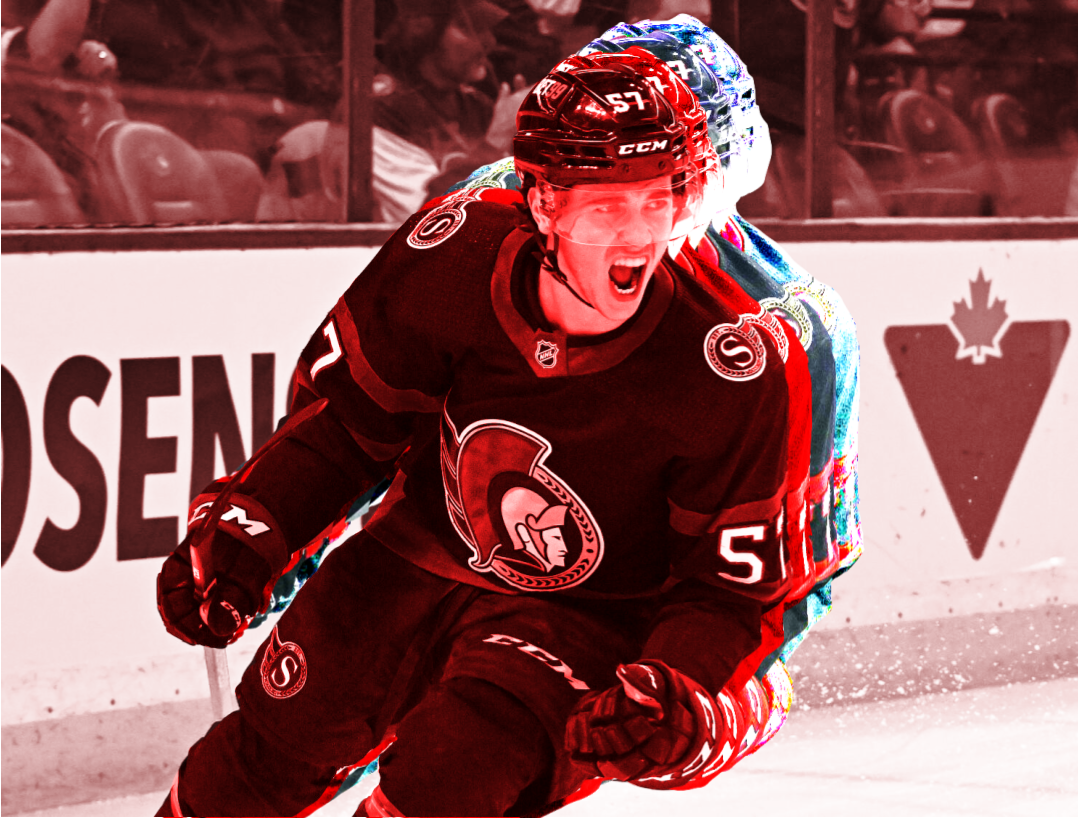

We have made it folks. Although the gruelling off-season drought was mitigated this year thanks to an excellent Cup Final pushing into late June, hockey making its return is still as satisfying as ever.
Most of you know I’m a Senators fan, so I thought I’d take the first month of October here at LB-Hockey to preview Ottawa’s 2024-25 season. Rather than doing a traditional season preview, I wanted to take more of a player-focused approach that makes full use of our suite of analytical tools.
I’ll go through all the main pieces and highlight a certain aspect of their game that is likely to be a focal point in their success and the team’s push to attain that elusive playoff spot. These could be skills with the potential to see large developments, tendencies that need to be addressed, or how the player’s environment this year may affect them.
This article is part 1 which will be featuring the forwards, while part 2 should come soon after, covering the defensemen and goalies. So without further ado, let’s dive right in with what could be Ottawa’s biggest addition through internal improvements…
Tim Stützle
A 76-point pace is fantastic but was seen as slightly anticlimactic by most Sens fans for their Süperstar forward. Coming off the heels of hitting the 90-point mark and being one post shy in game 82 of 40 goals, Tim Stützle seemed poised for a massive 2023-24 season.
Unfortunately for him, that was made immediately more difficult when he sustained a wrist injury in game 4 which he played through for the rest of the season. Tack on a shoulder injury later in the year, and it was a tough road for Timmy who persisted and put up another 70+ point season.

It was easy to see how that injured wrist affected him. Although his passing and zone entry game remained elite, it limited his shooting ability which took a massive step the season prior. There were many instances where Stützle passed up shot opportunities and opted for a pass instead. It also manifested in him not being as willing and forceful in attacking the middle during offensive zone cycling sequences, reverting slightly to his draft-year self. So not only did his finishing take a hit, but so did his overall ability to generate offense.
What regressed the most due to this injury, however, was his breakout ability which had been in near top-of-the-league form since 2022. With an injured wrist, it’s much harder to make quick puck-protection plays while fending off pressure. This can throw off your calibration with how much pressure you can/want to invite while still being able to escape it and put your team at a transition advantage. His success rate on d-zone puck touches tanked as a result and the frequency of those attempts waned as the year went on.
There are few little things I love more than watching Timmy spin off an opposing forechecker, evade their poke-checks, and either dart down the wing or send a rocket of a pass up the middle to spring Tkachuk or Giroux on a breakaway. So having this skill back in top shape would be massive, especially given that his two common wingers are less speed & transition-oriented.
Now keeping with the theme of (hopefully anyway) healed injuries…
Josh Norris
Oh what hasn’t been said about Josh Norris’s left shoulder. Simply having him in the lineup consistently would be a relief for the majority of Sens fans at this point. But that doesn’t need to limit our analysis here.
The main draw with Norris is obviously the goal-scoring potential, thanks to a deadly powerplay one-timer that led him to a 43-goal pace in 2021-22. The shoulder still possibly being hampered casts some doubt on whether he’ll be able to leverage a skill that heavily utilizes the point of injury back to its peak performance.
Obviously, the scoring pace was not the same in 2023-24, but not only was Norris still clearly below 100%, the environment didn’t really allow him to put himself in positions that truly maximized his strength.
Previously, Ottawa’s powerplay structure was geared towards feeding Norris one-timer opportunities at the top of the right circle. Sure it was partly a consequence of not having many other options, but it also speaks to how effective and potent Norris was in this position. In the past 2 years, the surrounding PP cast has grown stronger and now includes various options from Stützle barreling downstream, Batherson-Tkachuk bumper plays, Pinto 1Ts in the high slot, etc. This led to Josh being moved around and off that right circle throughout the season.

(per NaturalStatTrick)

(per NaturalStatTrick)
So while the Sens have been generating a higher volume with Norris on the ice, it hasn’t resulted in more specifically for the American centre. Comparing the 2021-22 & 2023-24 seasons, we can see a drop-off in efficiency and volume on the player side while, when on the ice, his team’s results rose.
Simply put, they have not been needing to force 1Ts to Norris anymore, but it doesn’t mean that this option should be removed entirely. A middle ground likely benefits Norris individually and the Sens’ overall results here. Ideally, they can attain a solution where the PP units are developed to use Josh as a threat that can either have the gravity to pull defenders out of position to make use of those other aforementioned options, or simply fire home a laser beam himself should he stand uncovered.

When it comes to 5-on-5 play, I’d love to see him blend shooting and athleticism into better conversion off the rush. He’s always had a marvellous stride that when combined with his great fitness levels, provides him excellent top speed & agility. While this has resulted in good zone entry numbers, it hasn’t quite done the same for the next step of the process: generating chances off those entries.
It’s a similar story on the defensive side. He’s always been lauded as a strong two-way centre throughout his development, and that mix of defensive effort & instincts is reflected in his high rate of d-zone retrievals. It just hasn’t materialized in concrete suppression ability, yet anyway.
The tools are there for Norris, he just needs the opportunity to apply them with consistent healthy ice time.
Drake Batherson
Although it only resulted in a 4-point increase, most Sens fans would tell you it was a bounce-back season for Drake Batherson last year. His play in the defensive zone, even-strength production, finishing ability, and puck retrieval skills improved on the previous season.
Batherson thrives on controlled offensive plays, whether that’s off the rush or during lengthy cycles. Although he’s good but not great at setting up those possessions, posting just fine entry efficiency & dump-in recovery numbers, his skills really shine when he’s given time and space. And that is the biggest reason as to why so much of his production comes from the powerplay, where opposing defences are forced to withhold more direct pressure.
Drake gets open to funnel passes in and out to his teammates, contributing strongly in continuing the flow of Ottawa’s offense toward chances. His goal-line-to-slot set-play with Brady carries a lot of influence over how the Senators’ offensive sequences unfold. However, he could bear to diversify his approach a bit to elevate his overall offensive tendencies. And that’s where a potential returning duo could cover for this.


Oppositely to Batherson, Josh Norris has helped the Sens a lot in that aspect recently. With his usual 1T fading at 5v5 last season, Josh posed as a strong support option who connected a variety of less common offensive plays. This gave the team more flexibility to progress offensive zone possessions when their go-to options were covered and inaccessible.
Re-uniting the pair with Norris coming off injury could really help the Sens bolster a well-crafted offensive 2nd line.
Claude Giroux
With Ullmark now extended, Claude Giroux becomes the highest-profile player on an expiring deal. He has continued to be a very effective offensive creator and is one of the most consistent Senators night in and night out. There isn’t a lot to say about him aside from the hope of another year where he produces far above the age curve expectation.
One thing I am intrigued by though is how the new regime under Travis Green may potentially bring back a certain part of his game. Despite being known for his offensive output, Giroux was also an especially solid defensive player at the end of his tenure with the Flyers. That isn’t to say that he’s been making lots of mistakes in the d-zone with Ottawa, but rather that his more passive defending style hasn’t quite yielded the suppression results he attained previously.

And I do wonder if much of that can be attributed to a DJ Smith defensive scheme that struggled as a system in the back third of the ice. Breakdowns characterized that era, with last-second shutdown attempts being necessary to stop high-danger chances against. Unfortunately, that style of play does not favour a defensively passive yet effective player like Giroux. So it’s possible that with this new coaching staff, Giroux is able to play to his strengths on the other side of the puck.
Especially if his point production does start to regress due to age effects, that potential defensive jump would do wonders for not only his overall impact, but to round out that top line with Tkachuk & Stützle.
Ridly Greig
Speaking of Giroux, someone who strongly benefitted from centering him upon their arrival into the NHL is Ridly Greig. One of the most contentious players in the league last year, Greig didn’t have the same luxury as he did during his 2022-23 stint. With the Sens missing a variety of players due to injuries & suspensions, he went from having above to below league-average quality of teammates for his first full season.

That is best portrayed by having his two most common linemates changing from Claude Giroux & Alex DeBrincat in 2022-23, to Mathieu Joseph & Dominik Kubalik in 2023-24 (per NaturalStatTrick). A bounce-back on that front seems to be on its way for the upcoming season as he’s starting the year on a line with Josh Norris & Drake Batherson.
This could lay the groundwork towards a potential breakout season for Greig’s production. With 13G 13A last season, his offensive identity is not fully developed. Aside from some bumper work on the 2nd powerplay unit, he has yet to adopt a specific role on offensive possessions. And that can be seen from his development matrix which plots skill frequency vs success rate. Greig’s sees the majority of his skills being fairly clustered towards the centre, whereas most skaters have a more extreme and spread-out arrangement.
This is not necessarily a bad thing and just shows that there hasn’t yet been much specialization in his game. There aren’t many glaring inefficiencies nor are there huge standout strengths, with a possible exception for the latter being his checking game.

Ridly provides the most value when he’s shadowing opposing players. Even if he doesn’t quite get takeaways himself at a high volume, his ability to apply pressure and force puck carriers into making mistakes helps to stop forward progress for the enemy team, and start possessions for his own very effectively. I’m hoping to see him elevate that skill and engage it even more often moving forward.
He’s also been good at entering the zone with control. Again, he just hasn’t put himself in the position to carry it in as often as he should given his efficiency so far. Being that guy who helps turn pucks over and establish cycles in the offensive zone would be excellent when being paired with two possession extenders like Norris & Batherson.
To take it even further and truly cement his spot as a top-6 forward, he needs to further integrate himself in those sequences, since as of now, he’s a bit of a passenger offensively. When it comes to puck movement, plays don’t necessarily die on Greig’s stick, but he’s having trouble connecting with his teammates. Whereas on the scoring side of things, he isn’t pulling opposing defenders out of position to create room on off-puck routes at the moment.
By putting some emphasis on anticipating his linemates’ tendencies on the cycle, and getting a better feel for open pockets of space during those plays, he could have much greater command over Ottawa’s offense and add an extra layer for the opposing team to solve.
I know what I’m outlining is more of a multi-year development plan at this point for Ridly, but having two high-octane offensive lines is crucial for the team’s playoff contention window.
Brady Tkachuk
I have loved watching Brady Tkachuk’s game evolve over the last few years. Watching the captain ascend to becoming one of the league’s premier checkers has been a delight. In our model, it’s no surprise to see Brady and his brother top the charts in the checking category of our multi-year cards.

What’s been most impressive to me is the speed at which he has elevated the rest of his game. He’s still an influential power forward who dominates the front of the net, but that doesn’t entirely define his game anymore.
Over the last four years, Tkachuk has diversified the way he generates offense. When cycling, he doesn’t just force shots in tight, but consistently finds his teammates for chances of their own too. He’s also quite the threat in-movement now, by both carrying a high volume of pucks into the zone and turning those entries into dangerous plays, on which he scores at a pretty efficient rate.

And although his close-range finishing numbers are still rather low due to his net-scramble-heavy style, he’s in the top quarter of the league at converting chances from afar over the last 3 years.
The most impressive development of all is his capacity to limit opposition offense. Brady has always had the tools to impose a physical shutdown presence when on the ice, but that didn’t return tangible strong defensive results for his first few years in the league. Since 2022 however, his suppression numbers have risen drastically year-over-year, culminating in a ranking well above league-average last season.
With his other skills seemingly plateauing, I wonder if Tkachuk’s defensive ability continues to rise as it hasn’t shown any signs of slowing down. Between Brady turning his power game into true shutdown prowess, Giroux’s defensive style being more in tune with Travis Green’s system, and Stützle returning to form as a zone exit beast, the Sens’ top line has the chance to take its spot as one of the best play-driving trios in the league.
Michael Amadio
Following in Ryan Dzingel, Derick Brassard, & Tyler Ennis’s footsteps, Michael Amadio is the newest Sens returnee. With the Ullmark acquisition dominating Ottawa’s class of newcomers, it’s been easy to let the rest fade into the background a little bit. Amadio has the potential to be the most underrated from that group.
It’s hard to find many flaws in terms of what Michael Amadio brings to this group. Sure his point production isn’t outstanding, but he’s got enough offensive ability to keep plays going mostly thanks to his off-puck routes. Meanwhile, the rest of his game is very well-rounded. In the defensive zone, he’s positionally sound, retrieves pucks, and rarely turns over recoveries as they often result in clean breakout sequences. That puck-movement skill also materializes in zone entries whether that’s through carrying it himself, passing it in, or beating defenders to dump-ins on the forecheck.

The Sens have lacked this profile of player during the rebuild: a versatile middle-6 winger who can play in nearly any capacity and with any linemates. Given the propensity to injury of some Ottawa forwards, he should provide much-needed flexibility on the depth front, which the team has really lacked in recent years.
Thanks to his compatible style of play and cup-winning experience, look to Amadio as a candidate for being a model of stability that brings consistent efficiency throughout the season.
David Perron
Keeping with the July 1st signings, David Perron is easily the more well-known name of the bunch. He’s the embodiment of a veteran signing as a former cup-winner who has succeeded with various teams through good production on the ice, and off-ice contributions as part of their leadership group.
Looking at his impact over the last few years in our model here, it took a fairly big dip last season. The offense didn’t fade too much as his point pace only dropped by six to 50 over a full season. His checking and defensive numbers remained at around league average throughout his team in Detroit. So why the drop in valuation?

The biggest fall-off in his tracked data came from the puck-movement category. Both in terms of transitioning the puck out of and into the zone, Perron’s numbers fell drastically as is portrayed in his progression chart above. It seems like a fairly extreme shift for a player who sustained his production and didn’t undergo a change in environment. Turns out, his deployment could be a huge factor here.
After some digging, Perron’s most recurring line was with Larkin & Raymond who are very high-profile transition beasts. It would be natural to assume that those two were thus tasked with the bulk of the neutral zone work. With Larkin & Raymond being in charge of moving the puck up the ice, the opportunity for Perron to do so would be limited. So it could be less of a drop in carrying ability for him, but rather smartly deferring to more skilled players in that area.

So it could be less of a drop in carrying ability for him, but rather smartly deferring to more skilled players in that area. Given his age and play style, it’s likely a combination of both personal progression and this specific environment effect. To which degree each of these factors contributed is a plot point I will definitely be keeping an eye on throughout the upcoming season. Either way, pairing him with a proven transition artist on the right wing like Amadio or Batherson is something the new coaching staff should strive to build on.
Shane Pinto
Let’s close it off with one of the Senators’ biggest bright spots from last season’s second half. Upon returning from his 41-game suspension, Shane Pinto had an immediate impact both on the individual and team side. In his first 8 games back, Pinto clicked at a point-per-game pace (3G-5A-8PTS), leading the Sens to a 6-1-1 record over that stretch. Not only was he contributing on the scoresheet, but he actively made his teammates much better in the process.
This is reflected in our Impact on Teammates metric. By calculating how much a certain player improved his teammates’ expected goal share when they played with him (weighted by ice time together), we can estimate his impact on their performance. Pinto ranked highly here, landing in the top 10 across all 2023-24 forwards. Even more impressive is how he accomplished this in his age-22 season, easily the youngest in that top 10. Only Noah Cates (24) came close, with the next youngest after that being Conor Garland (27).

There’s still some developmental runway for Pinto, and the fact that he’s already boasting such exceptional play-driving numbers and a very well-rounded game is impressive. It should allow Shane to focus on elevating more dynamic features, whereas others would be needing to refine inefficiencies and further adapt to the top professional level. The rapid development of his playmaking ability, which has gone from being one of his biggest weaknesses during his draft year to a prominent strength now, is an example of this.
With an improved cast of wingers around him, and a potent high-slot one-timer role on the 2nd powerplay unit next to Giroux, Shane Pinto is poised to continue improving and be the beneficiary of a noteworthy breakout season.
Look for part 2 where I will go over the defensemen & goalies, coming soon out now!